Original power tool batteries are expensive, and sooner or later most tool owners ask the same question: can I use a different battery, or another brand’s battery, in the tool I already own? The honest answer depends on what you mean by “compatible.”
This guide explains why the major platforms don’t swap, what “compatible pins” really means, why the protection circuit matters more than the connector, and what to check before you buy or stock a third-party battery.
Why Makita, Milwaukee, DeWalt and Bosch batteries don’t swap
Every major brand builds its cordless tools around its own battery platform. Inside a platform, batteries are interchangeable: any Makita 18V LXT battery fits Makita 18V LXT tools, and any Milwaukee M18 pack fits M18 tools. Across brands, they are not. The rails, latches and contacts on top of each pack are different, and so is the electronics that lets the tool and the battery communicate.
Even within one brand there can be several separate systems. Makita, for example, runs 12V CXT, 18V LXT and 40V XGT platforms, and they are not cross-compatible with each other. Bosch likewise separates its Professional range from its DIY range.
Voltage labels add to the confusion. DeWalt’s “20V MAX” and Milwaukee’s “M18” packs sit in the same nominal 18V class; the 20V figure refers to peak voltage with no load. A number on the label does not tell you whether two batteries will fit, or work safely together.
What “compatible pins” really means
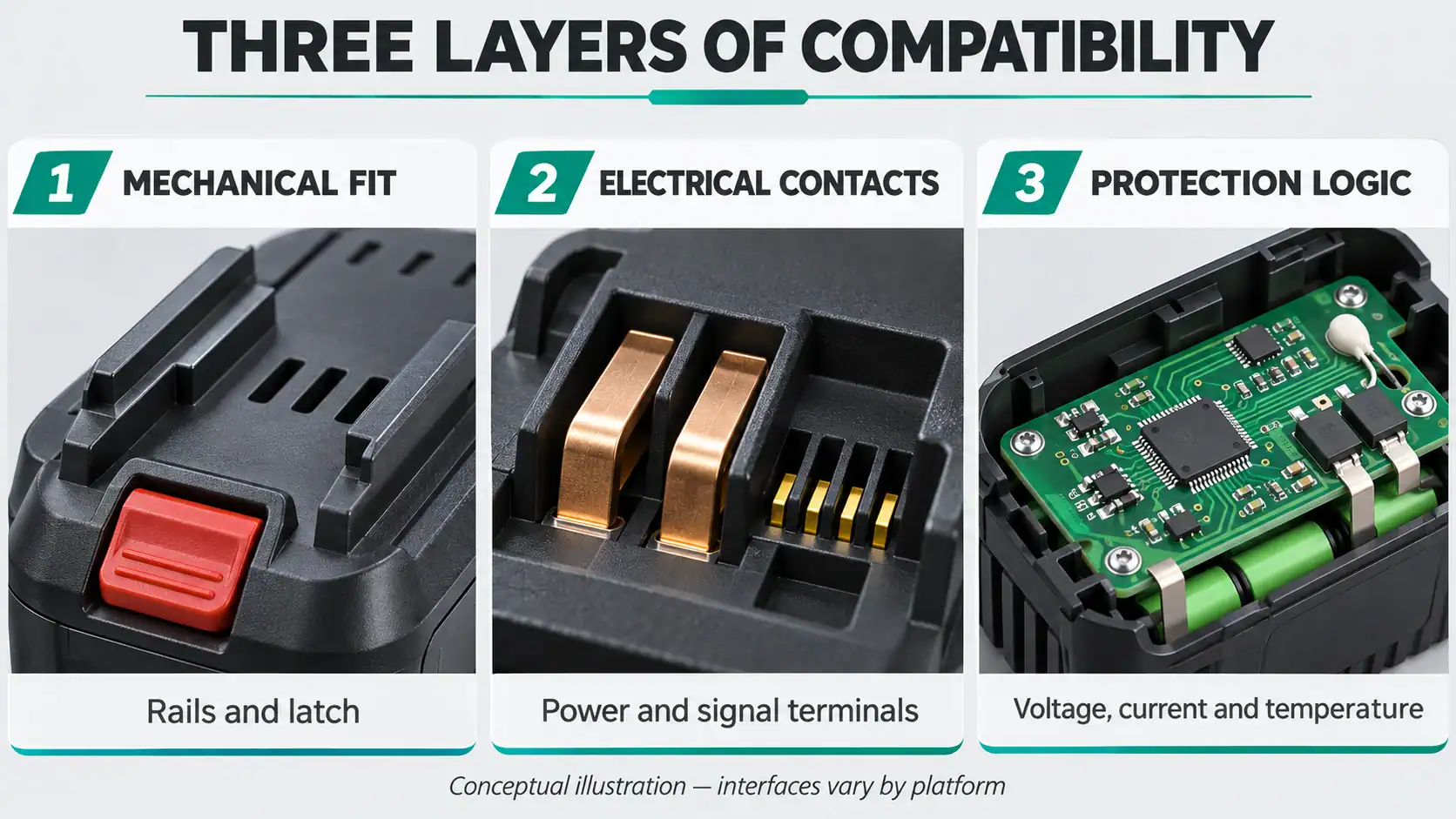
When a seller says a battery has compatible pins (terminals), that describes only part of the picture. Three layers decide whether a battery works properly in a tool:
| Layer | What it covers | If it’s wrong |
|---|---|---|
| Mechanical fit | Housing, rails and latch | The pack won’t seat, rattles, or loses contact under vibration |
| Electrical contacts (pins) | Power terminals plus signal terminals, such as temperature sensing and communication | No power, intermittent cut-outs, or a tool that can’t read the pack’s condition |
| Protection logic | The protection board (BMS) that decides when to limit or cut power | The pack fits and runs, but nothing reliably stops overcurrent, over-discharge or overheating |
Pin compatibility is necessary, but it is the protection layer that determines whether a pack is safe to use day after day.
Where should protection live when the tool and charger don’t match?
This is the question that separates a good compatible battery from a risky one. When a battery is used with a tool or charger it was not originally designed for, any protection that lives in the tool or the charger can no longer be relied on. There are two ways to deal with that.
There are two ways to keep a battery protected when it is used with a tool it wasn’t originally made for:
| Adapter approach | Protection inside the pack | |
|---|---|---|
| How it connects | An adapter bridges two platforms that were never designed to work together | The pack uses the target platform’s pin layout directly |
| Extra parts | An adapter sits between the tool and the battery | None: the pack clicks straight into the tool |
| Where protection lives | In the tool and charger, outside the pack | Inside the pack, so it goes wherever the pack goes |
| Temperature and status signals | The tool may not get the signals it expects, and the battery can’t tell how hard the tool is working | The pack’s own circuit monitors temperature, current and voltage |
| Best suited for | Occasional light work | Everyday use, provided the pack is well built |
Some independent tests of adapter pairings have shown reduced speed and power, and Bosch and Milwaukee advise against adapters and non-approved batteries, so check your tool’s warranty terms before relying on either route.
What full protection inside the pack should cover
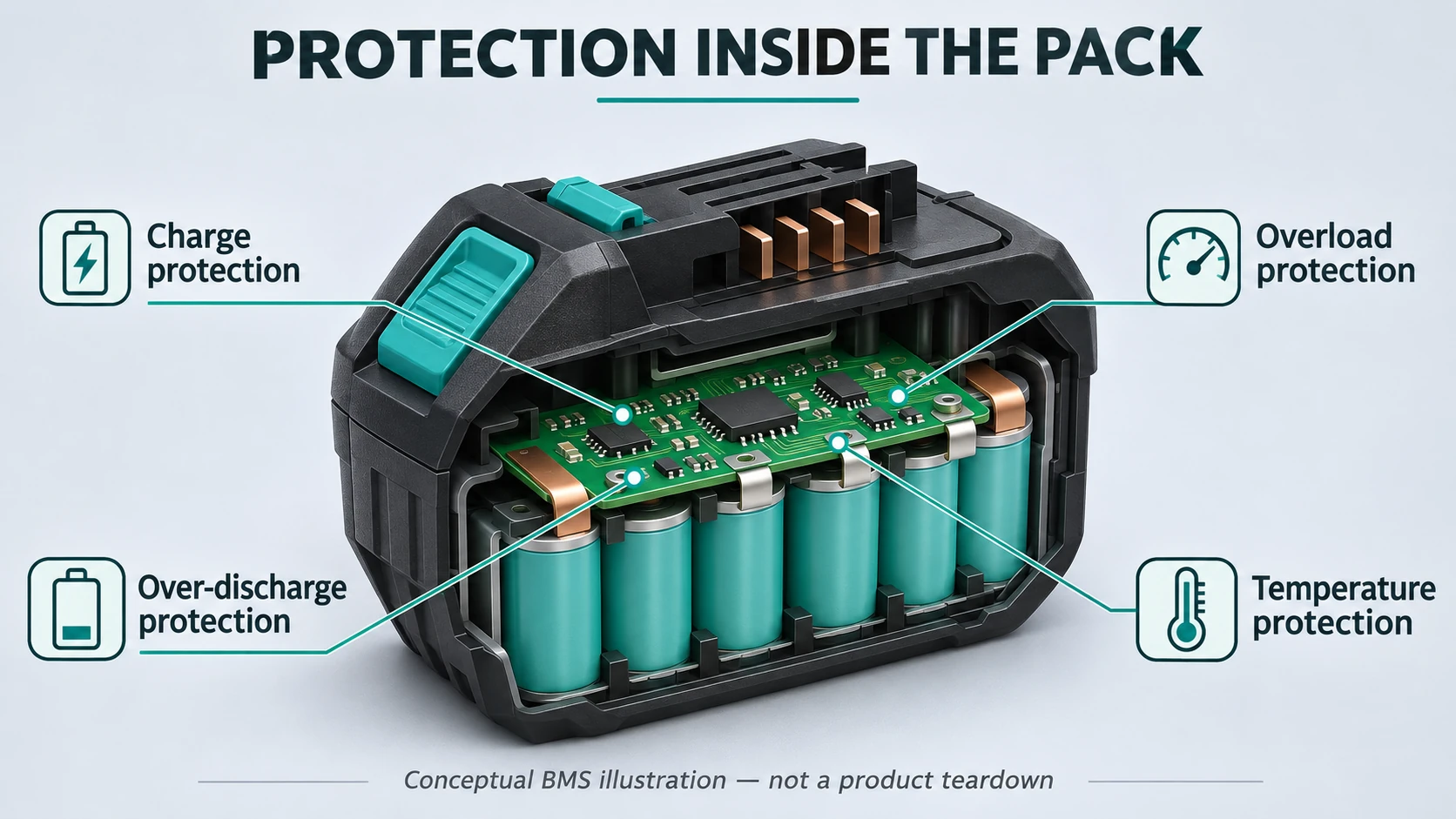
EXTOL’s SHARE20V battery packs are built around this principle. Instead of relying on external cut-off, the protection is integrated into the electronics inside the pack. It covers:
- Charging protection. Overcurrent, overvoltage and overcharge cut-off during charging.
- Overload protection. The pack limits excessive current draw from the tool.
- Over-discharge protection. The pack stops discharging before the cells fall to a damaging voltage.
- Temperature protection. Protection at temperatures that are too low or too high, with a rated working range of −10°C to +40°C.
Makita pins: a direct-fit interface, not an adapter workaround
The Makita 18V LXT system is one of the broadest slide-style battery platforms in the professional power tool market. Makita itself describes it as the world’s largest compatible 18V slide-style battery system, with more than 350 compatible products. That scale is why the Makita pin layout has become the practical standard for third-party packs designed to fit directly.
EXTOL’s battery packs use this pin layout as their interface. They slide straight into compatible Makita LXT-style tools, with no intermediate connector, no adapter module and no external bridge. The click of the latch, the contact of the terminals and the on-board protection circuit that takes over from there are all part of the same pack.
Capacities run from 2.0Ah to 8.0Ah (2.0Ah, 4.0Ah, 5.0Ah, 6.0Ah and 8.0Ah). For distributors and retailers, that means a full range from light-duty to heavy-duty use can be built on a single pin platform, without sourcing from several suppliers whose packs don’t match each other.
For buyers the distinction matters: “compatible interface” should not mean “works with an adapter.” It should mean the pack itself is the interface.
Lead-free, flame-retardant boards: a compliance signal, not just a safety spec
The protection boards inside EXTOL’s packs are made from lead-free, flame-retardant materials. At retail this can sound like a footnote. For professional buyers it is a signal about documentation and market access.
Buyers in Europe increasingly expect battery suppliers to meet RoHS and REACH material restrictions, and to provide safety documentation such as UN 38.3 (transport), CE and IEC/EN 62133 (battery safety). Certain brominated flame retardants, for example, are restricted under RoHS. A lead-free, flame-retardant board construction keeps the pack’s materials in line with the expectations European buyers already apply elsewhere in their supply chain.
This belongs in the purchasing file alongside the BMS protection thresholds and the test summaries. EXTOL’s SHARE20V packs have been tested to EN 62133 and UN 38.3, which gives distributors a set of benchmarks they can file together with the pack’s protection and material specifications.
Are third-party batteries safe? A buyer’s checklist
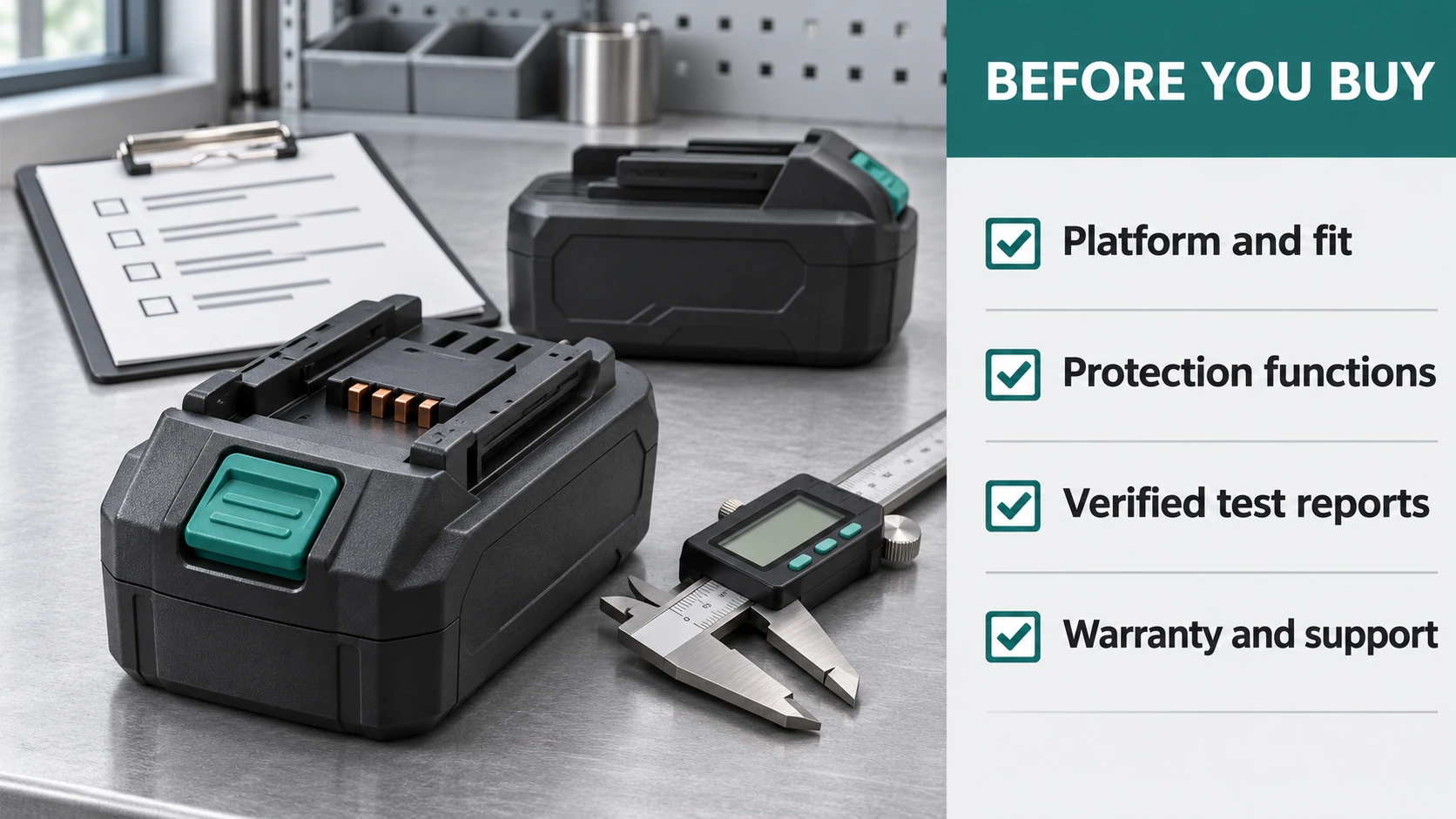
Quality varies widely in this category. Whether a Makita-compatible pack is safe depends on how it is engineered, not on what the label says. Before you buy or stock one, check these points:
- Protection functions. At a minimum: overcurrent, overvoltage, over-discharge, over-temperature and overcharge protection, and ask where that protection lives (in the pack, or in the tool and charger).
- A dedicated protection board. Look for a real protection circuit board, not just cells joined with wire.
- Board materials. Lead-free, flame-retardant boards are a sign the pack was built with safety and compliance in mind.
- Cells and capacity claims. The stated capacity should be consistent with the cells inside. Ask which cells are used.
- Test reports and certifications. Ask for documentation such as EN/IEC 62133 (battery safety), UN 38.3 (transport) and CE/RoHS, and check the report names and dates.
- Operating range. Check the rated working temperature range, and whether protection covers both low and high temperatures.
- Fit and finish. The pack should seat firmly, with clean, well-aligned contacts and a latch that holds.
- Warranty and support. A supplier who stands behind the pack will tell you plainly what is covered.
If you would like specifications, available capacities or pricing for EXTOL packs, contact our team or browse our batteries range.
What about Milwaukee, DeWalt and Bosch tools?
Each of these brands uses its own pin layout and electronics, so a pack built for Makita-style terminals is for Makita-style tools only. The same rules apply to any third-party battery, whichever platform it is for: confirm it was designed for your platform, and confirm it protects itself without relying on the tool.
Conclusion
“Compatible” has three layers: the mechanical fit, the electrical pins, and the protection logic. A battery that only satisfies the first two will fit and run, but the third is what keeps it safe in daily use, and it is most reliable when it is built into the pack itself. When you compare Makita-compatible packs, look past the pin layout and ask where the protection lives, what the protection board is made of, and which test documents back it up. A supplier who can answer those clearly is usually the one worth buying from.
Makita, Milwaukee, DeWalt and Bosch are trademarks of their respective owners. Brand names are used only to describe compatibility. EXTOL is not affiliated with or endorsed by these companies.
Frequently asked questions
Can I use a Milwaukee or DeWalt battery on a Makita tool?
Only through a third-party adapter. The batteries don’t fit natively and the brands don’t support that combination, so treat it as a workaround rather than a standard setup.
Are DeWalt and Milwaukee batteries interchangeable?
No. They use different physical connections and different electronics.
Is a 20V battery the same as an 18V battery?
Often the nominal voltage is the same, and the 20V figure is the peak voltage. Matching voltage does not mean the packs are compatible with each other’s tools.
What does a battery protection board do?
It monitors voltage, current and temperature, and limits or cuts power when readings leave a safe range. This is what guards against overcharge, over-discharge, overcurrent and overheating.
Why does it matter that protection is inside the battery pack?
Because the pack is the one component present in every tool-and-charger pairing. Protection inside the pack travels with it, while protection in the tool or charger can be lost when the pairing is not the one the system was designed for.
Will a third-party battery affect my tool warranty?
Policies differ by brand and by country. Check the warranty terms for your tool; damage attributed to non-approved accessories may not be covered.