If you sell, import, or private-label power tools for the European market, you have almost certainly run into three letters that decide whether your shipment clears customs or gets stopped at the border: CE. CE certification for power tools is not a marketing badge — it is a legal requirement under EU law, and getting it wrong can mean blocked shipments, product recalls, or liability that lands squarely on your business rather than your supplier’s.
This guide breaks down exactly what CE certification means for power tools, which directives and standards actually apply, how the certification process works, and what to check before you place an order — whether you’re sourcing electric power tools, hand tools, or garden power equipment.
What Is CE Certification for Power Tools?
CE marking (from the French Conformité Européenne) is a declaration by the manufacturer that a product meets the essential health, safety, and environmental protection requirements set out in relevant EU legislation. For power tools, the CE mark tells customs authorities, retailers, and end users that the product has been assessed against the applicable directives and is legally allowed to be placed on the market in the European Economic Area (EEA).
It’s important to understand what CE marking is not: it is not a quality mark, and it is not issued by a single “CE agency.” Instead, CE compliance is a self-declared conformity system backed by technical documentation, testing, and — for certain product categories — third-party assessment by a Notified Body.
Which EU Directives Apply to Power Tools?
Power tools rarely fall under just one directive. Depending on the tool type, voltage, and power source, a single product may need to comply with several pieces of EU legislation simultaneously:
- Low Voltage Directive (LVD) 2014/35/EU — covers electrical safety for equipment operating between 50–1000V AC (or 75–1500V DC). Most corded electric power tools fall here.
- Machinery Directive 2006/42/EC (being replaced by Machinery Regulation (EU) 2023/1230) — covers mechanical hazards, moving parts, and overall machine safety. This applies broadly to power tools with rotating blades, chains, or cutting elements, such as circular saws, chainsaws, and lawn mowers.
- EMC Directive 2014/30/EU — ensures the tool neither emits excessive electromagnetic interference nor is unduly affected by it. Any tool with a motor, motor controller, or electronics needs EMC testing.
- RoHS Directive 2011/65/EU — restricts hazardous substances (lead, mercury, cadmium, certain flame retardants) in electrical and electronic components.
- Battery Regulation (EU) 2023/1542 — increasingly relevant for cordless power tools, covering battery safety, labeling, and end-of-life requirements.
- Outdoor Noise Directive 2000/14/EC — applies to garden power equipment used outdoors, such as lawn mowers, hedge trimmers, brush cutters, and chainsaws, which must meet guaranteed sound power level limits and carry the corresponding noise marking.
Identifying the correct combination of directives is the first — and most commonly mishandled — step in the CE certification process.
Key EN Harmonized Standards for Power Tools
Directives set the legal requirements; harmonized EN standards give manufacturers a practical route to demonstrate compliance. The most relevant standards for power tools include:
- EN 62841 series (replacing the older EN 60745 series) — safety requirements for hand-held, transportable, and garden power tools, with product-specific parts covering drills, grinders, saws, and more.
- EN 60335 series — safety of household and similar electrical appliances, relevant for some garden and cleaning equipment.
- EN 55014-1 / EN 55014-2 — EMC emission and immunity requirements for motor-operated tools and appliances.
- EN ISO 12100 — general principles for risk assessment and risk reduction in machinery design.
- EN ISO 3744 / EN ISO 11201 — sound power and noise emission measurement, used to satisfy the Outdoor Noise Directive.
Compliance with harmonized standards gives a “presumption of conformity” with the directive’s essential requirements, which is why test reports referencing these exact EN numbers matter far more than a generic “CE certificate” with no standard listed.
The CE Certification Process, Step by Step
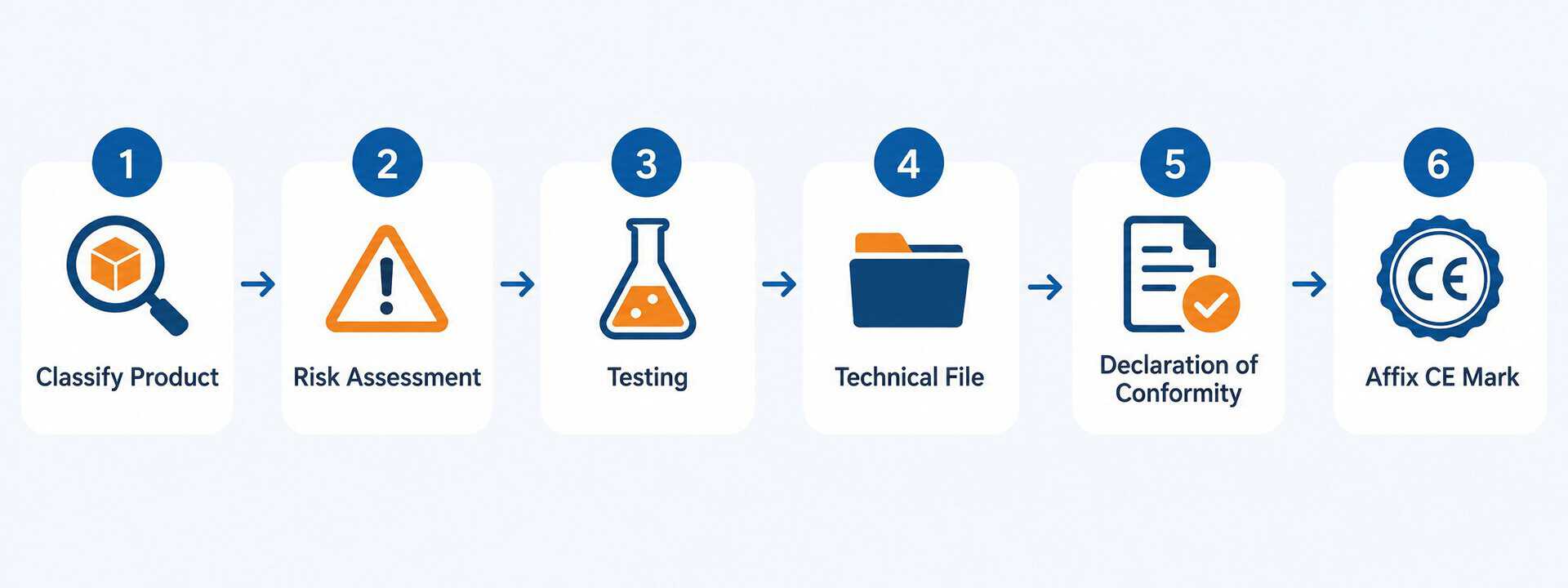
- Determine applicable directives and standards. Classify the product correctly — a cordless hedge trimmer, a corded angle grinder, and a hand-operated pruning saw all follow different compliance paths.
- Conduct a risk assessment. Identify mechanical, electrical, thermal, and noise hazards, and document how the design mitigates each one, typically following EN ISO 12100.
- Test the product. Testing covers electrical safety, EMC emissions/immunity, mechanical safety, and noise, usually performed by an accredited lab. For most power tools this can be done via self-certification (Module A); certain higher-risk machinery categories require Notified Body involvement.
- Compile the Technical Construction File (TCF). This includes design drawings, component specifications, risk assessment records, test reports, and user instructions — and must be kept on file for at least 10 years after the last unit is placed on the market.
- Issue the Declaration of Conformity (DoC). The manufacturer (or the entity acting as manufacturer, see below) signs a formal declaration listing the directives and standards met.
- Affix the CE mark. The mark is applied to the product, packaging, and accompanying documentation, following exact proportion and format rules.
Who Is Legally Responsible: Manufacturer, Importer, or Brand Owner?
This is where many buyers get caught out. Under EU product law:
- The manufacturer — whoever designs and produces the tool, or whoever’s brand appears on it — carries the primary legal responsibility for CE compliance.
- If you import tools under your own brand or private label, EU law treats you as the manufacturer, regardless of who actually made the product. That means you inherit the obligation to hold the full technical file, not just a certificate PDF.
- The importer (the EU-based entity placing goods on the market) must verify that the manufacturer has fulfilled these obligations before importing, and must be able to produce documentation on request from market surveillance authorities.
A factory-issued certificate is a starting point, not proof of compliance on its own. Buyers should always request the full test report, the Declaration of Conformity referencing the exact product model, and confirmation of which standards were tested.
Common Mistakes When Sourcing CE-Certified Power Tools
- Assuming one certificate covers every variant. Voltage, battery configuration, or even housing material changes can invalidate a test report for a “similar” model.
- Accepting a DoC without matching test reports. A Declaration of Conformity is a self-declaration — it should always be backed by underlying test data referencing specific EN standards.
- Overlooking noise certification for outdoor garden equipment, which requires separate compliance with the Outdoor Noise Directive.
- Not verifying the Notified Body number, when one is required, against the EU’s NANDO database.
- Treating CE as a one-time task. Design changes, new battery packs, or component substitutions can require re-testing.
Verifying Your Supplier’s CE Documentation: A Quick Checklist
- Does the Declaration of Conformity list the exact model/SKU you are buying?
- Are the EN standards cited relevant to your product category (e.g., EN 62841-1 for a power tool, not a generic appliance standard)?
- Do you have full test reports, not just a summary certificate?
- For outdoor power equipment, is there separate documentation for the Outdoor Noise Directive?
- Is the technical file available on request, and will the supplier commit to retaining it for 10 years?
CE-Certified Power Tools, Hand Tools, and Garden Tools from Extol
At Extol Tools, CE compliance isn’t an afterthought bolted on for export — it’s built into how each product line is developed and documented, across our three core categories:
Power Tools — Our corded and cordless power tools, including drills, angle grinders, and saws, are tested against the relevant Low Voltage, EMC, and Machinery Directive requirements, with documentation referencing EN 62841 and EN 55014 standards. Each SKU is backed by test reports and a Declaration of Conformity matched to that exact model, so buyers and private-label partners aren’t left guessing whether a “similar” certificate actually applies to what they’re importing.
Hand Tools — While hand-operated tools generally fall outside electrical directives, our hand tool range — from wrenches and pliers to cutters and building tools — is manufactured to relevant EN and ISO mechanical safety and material standards, giving distributors confidence in consistent quality and safety across bulk orders.
Garden Tools — Our garden power equipment, including lawn mowers, trimmers, chainsaws, and pressure washers, is certified not only under the standard electrical and machinery directives but also assessed for compliance with the Outdoor Noise Directive where applicable, alongside weatherproofing and vibration-reduction safety features for extended outdoor use. Manual garden tools such as shears, saws, and pruning equipment are produced to matching mechanical safety and durability standards.
Every category is supported by full technical documentation, making Extol a straightforward sourcing partner for retailers, distributors, and private-label buyers who need CE compliance to hold up under EU market surveillance — not just look right on a datasheet.
Final Thoughts
CE certification for power tools is a legal gateway to the EU market, not a formality to skim past. Understanding which directives apply, insisting on model-matched documentation, and knowing exactly who carries legal responsibility will save you from the customs delays, recalls, and liability issues that catch under-prepared importers off guard. Whether you’re sourcing electric power tools, mechanical hand tools, or outdoor garden equipment, always verify the paperwork behind the mark — not just the mark itself.
Looking for a wholesale supplier with verified CE-certified power tools, hand tools, and garden tools? Get in touch with Extol Tools to request documentation and discuss bulk pricing.