A garden irrigation pump moves water from a source — a well, a tank, a pond, or the mains — into a sprinkler or drip system, so the whole garden gets watered evenly and with enough pressure to reach every zone. Wells, tanks, rainwater collection, and larger gardens with pressure or distance limitations all rely on a pump to make the rest of the irrigation system work properly.
This guide covers the main types of garden irrigation pumps, how each one works, and what to weigh up before choosing between them.
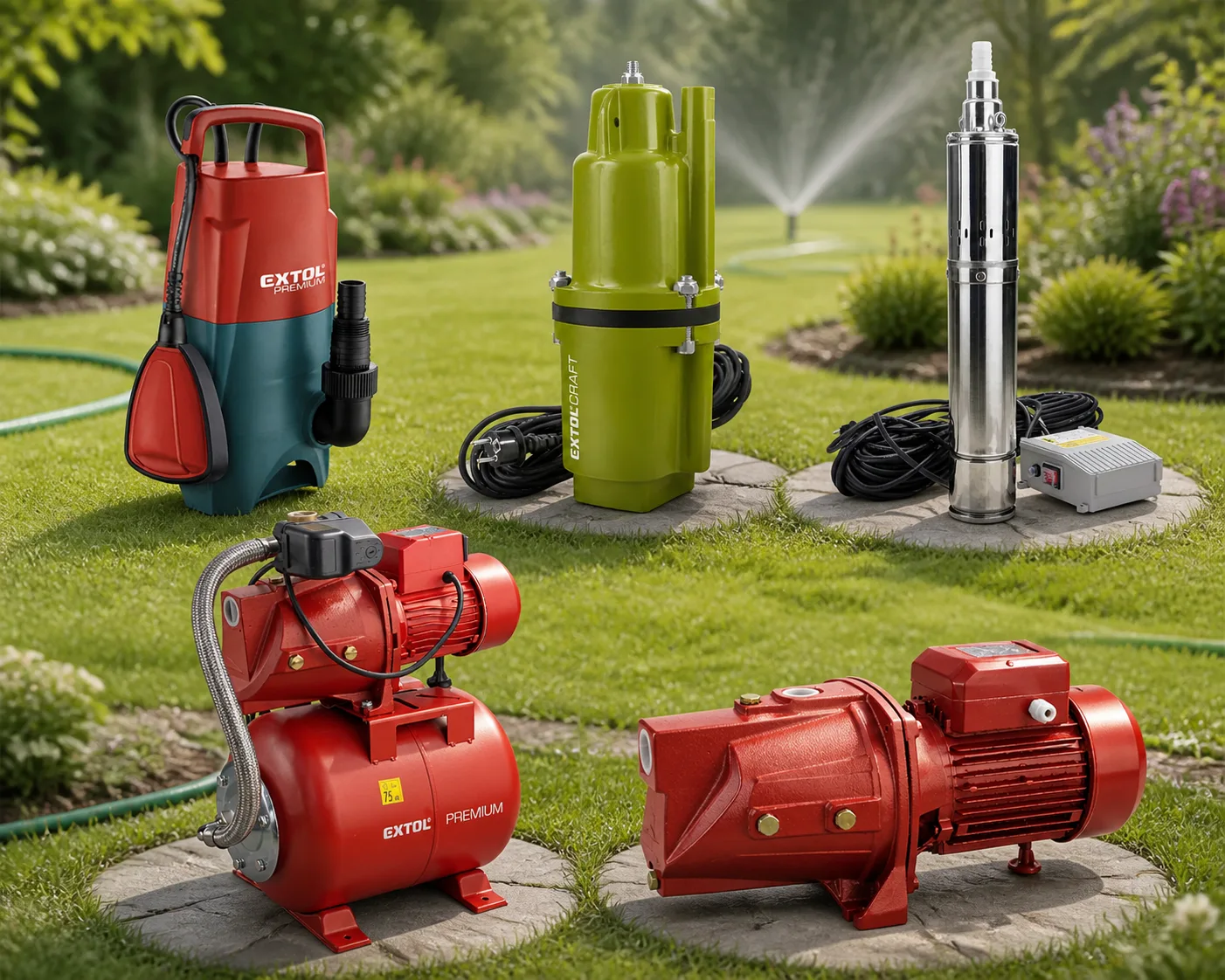
Types of Garden Irrigation Pumps
Submersible Pumps
Sits fully underwater — inside a well, tank, or rain barrel — and pushes water up and out through a discharge pipe.
Best for: shallow wells, cisterns, and rainwater storage, where the pump can sit close to the water with minimal setup.
Pros: quiet in operation, no priming needed, simple installation.
Cons: harder to access for maintenance or replacement, since servicing it means lifting it out of the water.
Surface Pumps
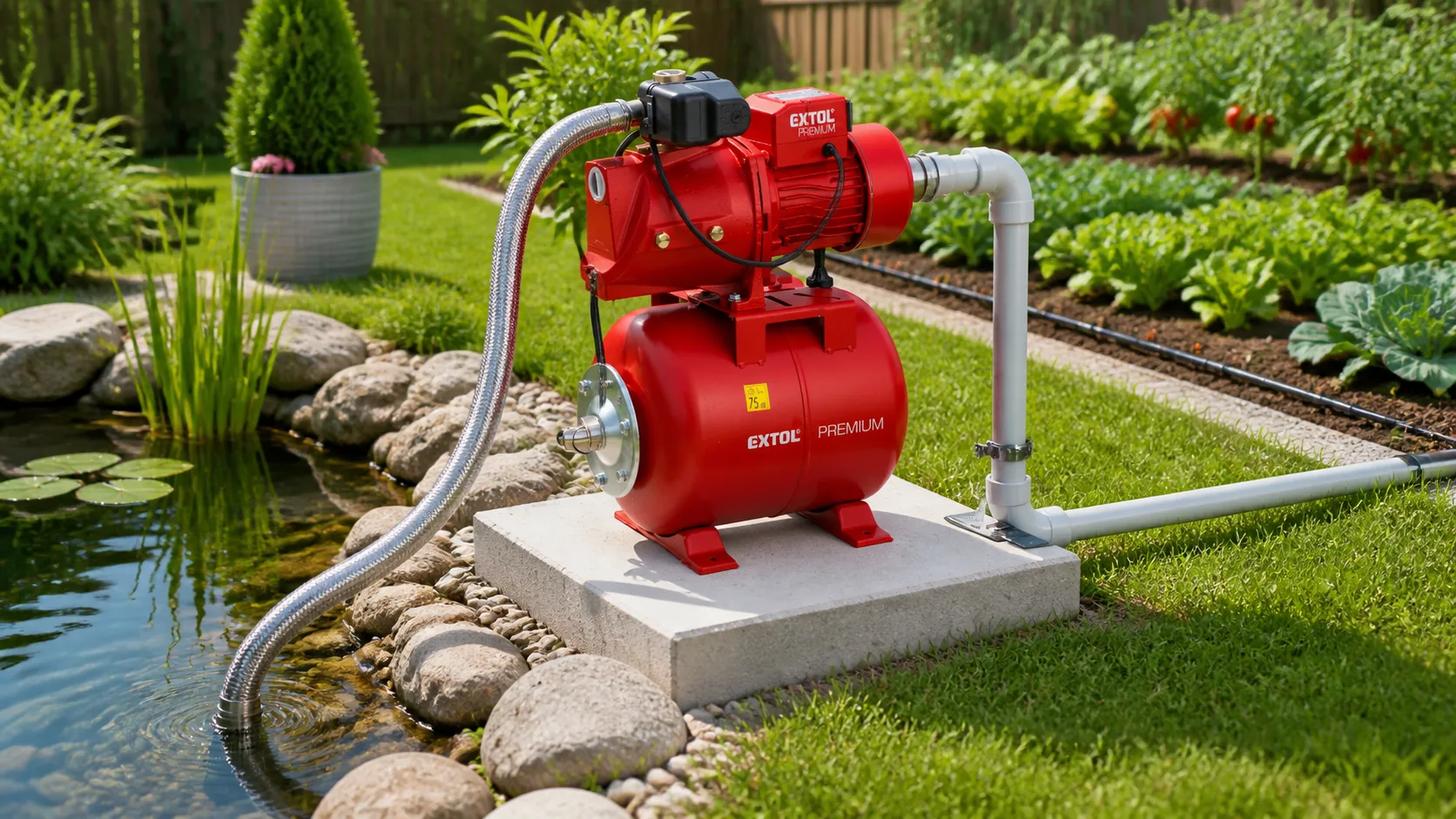
Sits above the water source — on a shelf, stand, or the ground nearby — and draws water in through a suction hose.
Best for: ponds, tanks, and larger gardens or multi-zone systems that need higher flow and stronger pressure.
Pros: higher flow rate and pressure than a comparable submersible pump, easy to access for maintenance.
Cons: needs priming before first use, and suction lift is limited to roughly 7–8 meters, so it can’t pull water from very deep sources.
Well Pumps
A submersible unit engineered with a narrower profile and depth-rated motor to fit down a borehole casing and run reliably at depth.
Best for: deep wells and boreholes, where a standard submersible or surface pump can’t generate enough lift to reach the water.
Pros: the only realistic option for genuinely deep water sources.
Cons: sized by maximum lift, which varies significantly between models — the wrong model simply won’t reach, so this figure needs checking against actual well depth before ordering.
Why Suction Lift Has a Hard Limit
The 7–8 meter suction lift figure for surface pumps isn’t a manufacturer spec — it’s a physical limit set by atmospheric pressure itself, which is why it applies across brands and models.
| Suction lift at sea level | |
|---|---|
| Theoretical maximum (perfect vacuum) | ~10.3 m |
| Practical maximum (real-world pumps) | ~7–8 m |
At sea level, atmospheric pressure can support a column of water up to about 10.3 meters — this is the absolute physical ceiling, not a pump design choice. No real pump reaches that figure, since friction losses, minor air leaks, and imperfect vacuum performance bring the practical, usable limit down to roughly 7 to 8 meters. This is why a submersible or well pump — which doesn’t rely on suction at all — is the only real option once a water source sits deeper than that. (Data cross-referenced from multiple pump engineering references, including Cornell Pump Company and Process Engineering.)
Factors to Consider When Choosing
Water Source
This is the deciding factor before flow rate or pressure even come into play. A shallow well, tank, or rain barrel points toward a submersible pump. A pond or accessible above-ground source usually suits a surface pump. A deep well needs a dedicated well pump built for that depth.
Flow Rate and Pressure
Match the pump to the system it’s feeding. A small drip irrigation setup needs far less flow than a multi-zone sprinkler system covering a large garden. Surface pumps generally deliver more flow and pressure; submersible pumps are usually the better fit for smaller, simpler setups.
| Irrigation type | Typical operating pressure |
|---|---|
| Rotor sprinklers | ~3.1 bar (optimum), 1.7–4.5 bar range |
| Spray heads | ~2.1 bar (optimum), 1–2 bar range |
| Drip lines | ~1.4 bar (optimum), 1–2 bar range |
Pressure that’s too low leaves dry patches and uneven coverage; too high, and spray heads mist instead of spraying properly, wasting water to evaporation and wind drift before it reaches the ground. The pump needs to comfortably cover the operating range of whichever irrigation type it’s feeding, not just its optimum point. (Source: Oklahoma State University Extension, irrigation pressure management guidance.)
Power Source
Electric pumps are the simplest option where power is available and need the least maintenance. For sites without reliable electricity, a petrol-powered pump is worth considering, though it typically costs more to run and service.
Maintenance Access
Think about how easily the pump can be reached once it’s installed. A submersible pump inside a deep well takes more effort to service than a surface pump sitting on a stand next to a tank — worth weighing against how often the pump is likely to need attention.
FAQ
Can a submersible pump be used above ground instead of a surface pump?
No. Submersible pumps are sealed for underwater use and rely on the surrounding water for cooling — running one dry or in open air can damage the motor. Surface pumps are built for exactly that situation instead.
How deep can a standard pump pull water from?
A standard surface pump is limited to roughly 7–8 meters of suction lift, regardless of brand, due to atmospheric pressure. Beyond that depth, a submersible well pump is needed instead, since it doesn’t rely on suction at all.
What’s the difference between flow rate and pressure?
Flow rate (measured in L/h or GPM) is how much water moves through the system over time. Pressure (measured in bar or PSI) is the force pushing that water through the pipes. A system needs both in the right balance — high pressure with low flow won’t cover a wide area, and high flow with low pressure won’t reach distant or elevated zones.
Can one pump run multiple irrigation zones at the same time?
It depends on the pump’s total flow and pressure output relative to the combined demand of all active zones. Running zones simultaneously requires more capacity than running them one at a time, which is why most irrigation systems are designed to run zones in sequence rather than all at once.
Do petrol-powered pumps perform differently from electric ones?
Petrol and diesel pumps are typically chosen for sites without reliable electricity, and can handle higher volumes in some cases, but they generally require more maintenance and cost more to run than an equivalent electric pump. Electric pumps are usually the simpler choice wherever a power connection is available.
How often should an irrigation pump be serviced?
This varies by pump type and usage, but checking seals, impellers, and pressure switches at the start and end of each irrigation season is a common baseline. Pumps running continuously or in harsh conditions typically need more frequent checks than ones used seasonally.
EXTOL’s Garden Irrigation Pump Range
EXTOL is a garden pump manufacturer producing submersible, well, and surface pumps for irrigation, water transfer, and drainage applications, manufactured to EU-standard quality control with CE certification available across select product lines.
The submersible pump range covers clean and wastewater applications with multi-stage impellers. Best for shallow wells, tanks, and rain barrels.
The well pump range includes deep well submersible pumps, diaphragm pumps, and booster pumps, with flow rates from around 1,000 to 2,000 L/h and lifts from 10 up to over 70 meters depending on the model. Best for genuinely deep water sources standard pumps can’t reach.
The surface pump range includes jet pumps with and without an integrated pressure tank, delivering up to 9,500 L/h at 3–4 bar. Best for larger systems that need higher flow and consistent pressure across multiple zones.
Browse the full garden pump range, or request a wholesale quote if you already have a spec in mind.