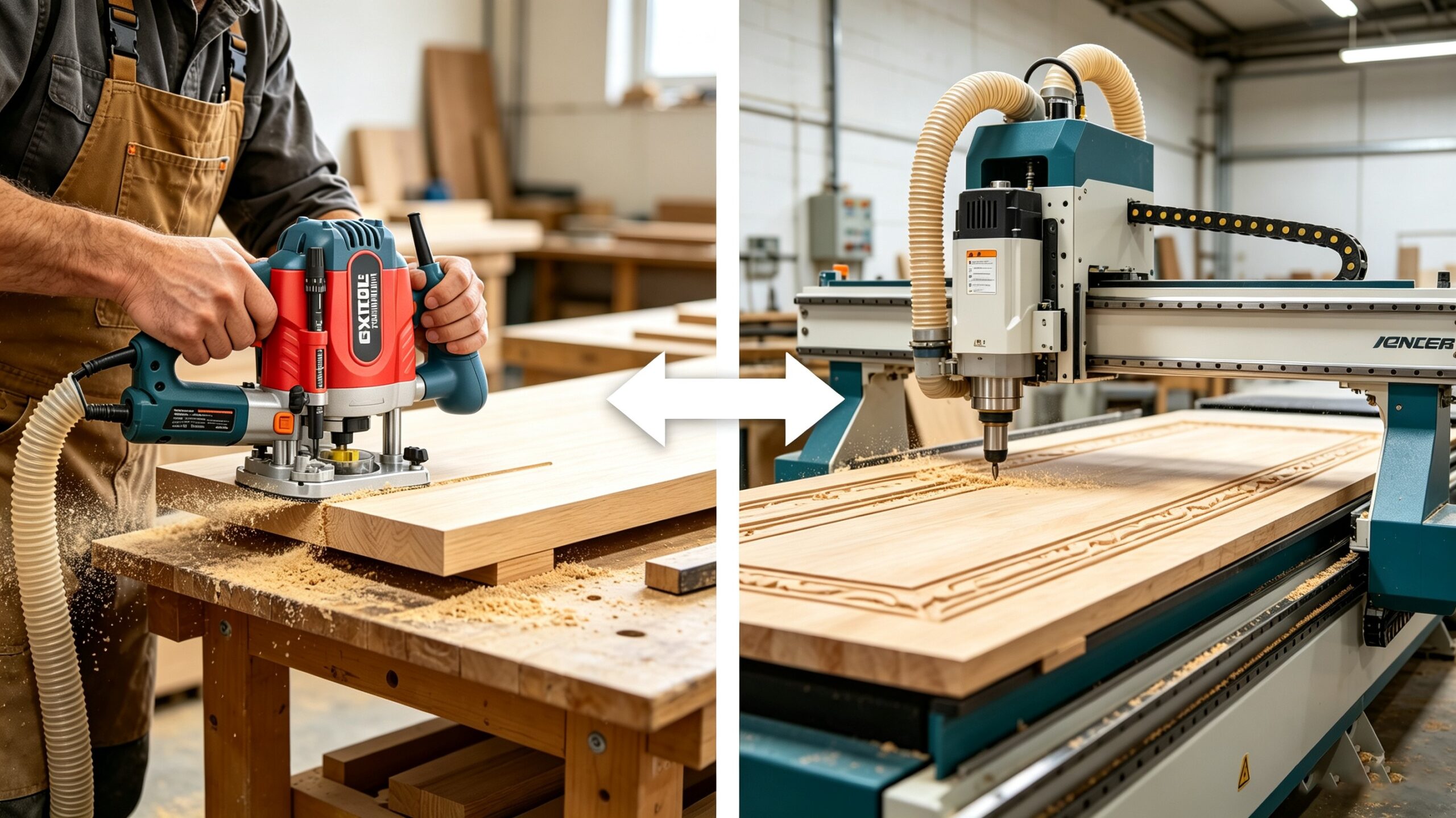
Search “wood router” and the results blur two completely different tools together — a handheld power tool a carpenter holds in their hand, and a computer-controlled machine that costs as much as a car. They share a name and a basic cutting principle, but almost nothing else. This guide draws a clear line between them.
What Is a Handheld Router?
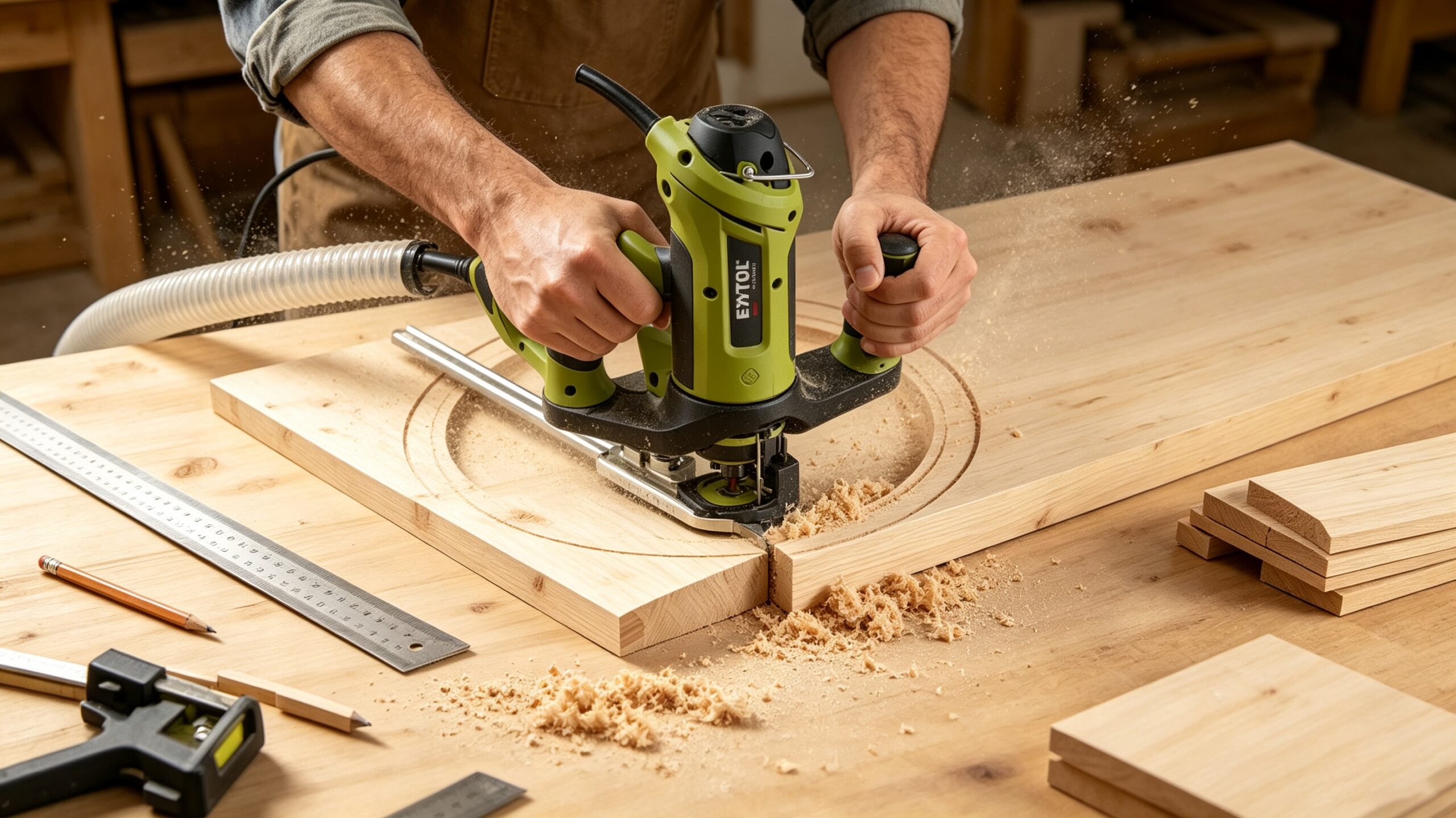
A handheld router is a power tool guided by hand, used for edge profiling, joinery, grooves, and decorative cuts on wood. The motor and cutting bit are self-contained in one unit — plug it in, guide it across the workpiece, and the depth and path are controlled entirely by the person holding it.
Handheld routers come in two base configurations.
A fixed base holds the motor at a set depth, which suits edge work and straight-line cuts where consistency matters more than mid-cut adjustment.
A plunge base lets the motor move vertically during the cut, which is what makes it possible to start a cut in the middle of a board — necessary for mortises, inlays, and stopped grooves that don’t run off the edge of the material.
Pros:
- Low cost compared to automated machinery
- No programming or setup — plug in and start cutting
- Fully portable, works on-site as well as in a workshop
- Simple to learn, even for a first-time user
Cons:
- Accuracy depends entirely on the operator’s hand control
- Repeating an identical cut across many pieces is slow and inconsistent
- Extended use requires sustained physical control, which gets tiring on long jobs
Best for:
- Edge trimming and decorative profiles on furniture and cabinetry
- Cutting grooves and dados for shelving and panel joints
- Joinery — dovetails, mortise and tenon joints, box joints
- On-site adjustments, like trimming a door or countertop after installation
What Is a CNC Router?
A CNC (Computer Numerical Control) router is a computer-controlled machine that cuts, carves, and shapes material automatically, following a programmed design file. Instead of a hand guiding the tool, the cutting spindle sits on a rigid frame — usually called a gantry — that moves it along multiple axes, typically X, Y, and Z, executing the same design repeatedly with a level of precision and consistency a hand-guided tool can’t match.
Some CNC routers also run multiple cutting heads at once, which lets them work on more than one part of a design simultaneously — something a single handheld router obviously can’t do.
Pros:
- High repeatability — every part comes out identical
- Handles complex, detailed, or 3D designs manual tools can’t replicate
- Runs largely unsupervised once programmed, freeing up labor
- Broad material compatibility, from wood to plastics to some metals
Cons:
- High upfront cost — the machine, software, and tooling all add up
- Requires CAD/CAM knowledge and setup time for every new job
- Stationary — doesn’t travel to a job site
- Standard 3-axis machines cut from directly above, which limits certain edge and side profile work
Best for:
- Furniture components and cabinetry, especially repeated parts
- Signage, engraving, and decorative panel work
- Architectural elements — facades, decorative panels, custom moldings in volume
- Mold and prototype production
Key Differences Between a Handheld Router and a CNC Router
| Handheld Router | CNC Router | |
|---|---|---|
| Control | Guided by hand | Computer-controlled, programmed |
| Typical speed range | ~10,000–30,000 RPM | ~3,000–24,000+ RPM, adjustable by material |
| Repeatability | Depends on operator skill | Identical on every run |
| Setup | None — plug in and go | Requires design file and machine setup |
| Typical cost | Low | Significantly higher |
| Portability | Fully portable | Stationary machine |
Handheld Router vs CNC Router: Which One Do You Need?
When to Choose a Handheld Router
- You’re working on one-off pieces or custom jobs
- Work happens on-site as often as in a workshop
- The job involves edge profiles, chamfers, or grooves along a vertical surface
- Budget or space doesn’t support a stationary machine
When to Choose a CNC Router
- You’re producing the same part repeatedly and need every unit identical
- The design is complex enough that hand-guided cutting isn’t practical
- Volume is high enough that the upfront cost pays back through labor savings
When You Need Both
Many workshops run a CNC router for volume production alongside a handheld router for on-site work, edge profiling, and the one-off jobs a stationary machine can’t easily handle. The two tools tend to complement each other rather than compete for the same job.
FAQ
Can a Handheld Router Be Mounted Into a CNC Machine?
Some hobby-level CNC machines do use a handheld router as their spindle, since it’s cheaper than a dedicated CNC spindle. This only applies to machines actually designed for it — a handheld router bought for manual work isn’t built to be retrofitted this way.
Do Handheld Routers and CNC Routers Use the Same Bits?
Often yes, since the cutting principle is the same — collet size and shank diameter just need to match. One limitation: CNC routers generally run shorter bits for rigidity, which can rule out some larger profile bits, like those used for crown molding, that a handheld router handles without issue.
Does Running a CNC Router Require Special Training?
Yes, more than a handheld router does. It involves CAD/CAM software and machine setup — a different skill set from guiding a handheld tool by hand.
EXTOL’s Electric Router Range
EXTOL is an electric router manufacturer producing handheld routers for wholesale distributors, retailers, and B2B buyers worldwide — not CNC machinery. These are the tools carpenters and cabinet makers hold and guide by hand, manufactured to EU-standard quality control with CE certification available across select product lines.
The Router 1250W runs at 12,000–30,000 RPM with 6mm and 8mm collet capacity, a side guide and guide wheel for oblique and circular profiles, and dust extraction compatibility.
The Router 1200W runs at 10,000–28,000 RPM with an aluminum base, adjustable milling depth, and a longitudinal guide with copy insert included.
The 3-in-1 Multi-Purpose Router 600W combines cutting, grinding, sanding, polishing, and engraving in a single tool, running at 10,000–30,000 RPM, with a circle-cutting attachment for decorative work.
Browse the full electric router range, or request a quote if you already have a spec in mind.